


Meniscus Root Tear: A Red Flag for the Future Knee Arthritis


Knee pain is one of the commonest reasons middle aged patients visit an orthopaedic surgeon.
Activity related constant knee pain, particularly after an incidence of slip and fall or an audible ‘pop’, is of a definite concern. This could be a sign of root tear of medial meniscus of the knee joint.
Peculiarity of this injury is that the acute pain subsides within a couple of months, hence patients tend to ignore it, but the symptoms return back once the arthritis starts to set in the joint.
In order to avoid challenges of tackling early arthritis in the middle age, recognising the symptoms early, and seeking timely treatment can make a significant difference in preserving your knee joint.
What is a Meniscus?
The meniscus is a C-shaped cushion made of tough collagenous tissue that sits between the thigh bone (femur) and shin bone (tibia). Each knee has two menisci:
Medial meniscus (on inner side)
Lateral meniscus (on outer side)
The menisci act as natural shock absorbers. They distribute body weight evenly across the knee, improve stability, reduce friction, and protect the cartilage covering the bones.
Each meniscus has 5 parts: anterior root, anterior horn, body, posterior horn & posterior root.
The posterior root is the point where the back end of the meniscus firmly attaches to the leg bone (tibia) like an anchor.
This attachment is crucial because it allows the meniscus to convert the body's weight into ‘hoop stresses’, preventing excessive pressure on the knee joint cartilage.
What is a Medial Meniscus Posterior Root Tear?
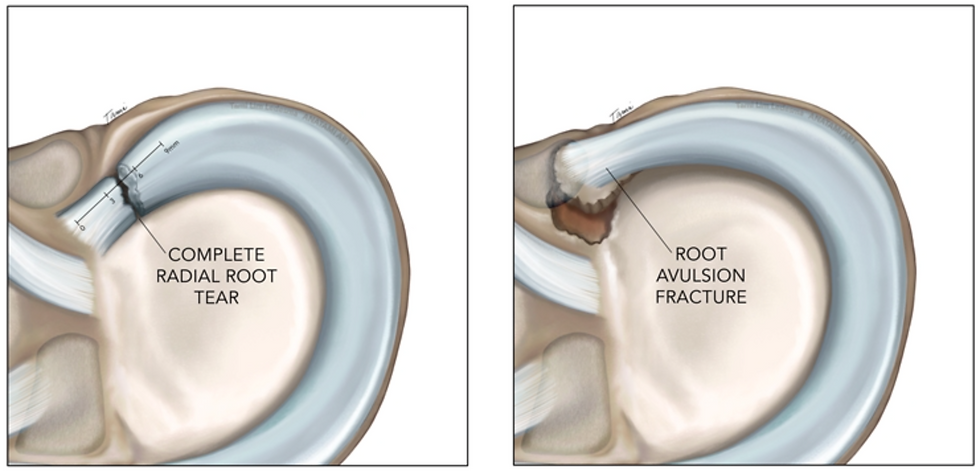
A medial meniscus posterior root tear occurs when the meniscus is torn away from its bony attachment at the back of the knee or when a tear develops in the meniscus within 9mm of this attachment.
Natural course:
Once the root is torn, the meniscus can no longer perform its shock-absorbing function.
The meniscus slips outward (called meniscal extrusion), leading to increased pressure on the cartilage and the bone.
In fact, a root tear behaves like the entire meniscus has been removed (meniscectomy), causing rapid wear and tear of the knee joint rapidly leading to arthritis in the middle age.
Who is at risk of getting a meniscus root tear?
This injury can affect anyone but is commonly seen in:
People above 40 years of age
Women > men
Individuals who are overweight or obese
Those involved in activities requiring deep squatting or kneeling
Patients who sustain a twisting injury while walking or climbing stairs
Unlike sports-related meniscus tears in younger patients, many root tears occur during simple daily activities.
What are the symptoms?
Patients often describe a sudden onset of pain on the inner side of the knee.
Some even remember hearing or feeling a ‘pop’ when the injury occurs.
Common symptoms include:
Pain along the inner side of the knee
Difficulty in walking, climbing stairs, getting up from chair
Swelling after the injury
Inability to fully bend the knee
Persistent pain despite rest and medications
Why is this injury serious? What are the consequences?
Many people assume that a meniscus tear is a simple injury that will heal with rest.
Unfortunately, root tears are different.

Once the root attachment is lost:
The meniscus moves out of position.
Shock absorption decreases dramatically.
Cartilage cover over bone experiences excessive pressure.
Knee arthritis develops much much faster.
Even if the pain sometimes gets better, it gradually comes back once the arthritis changes set in
Walking and daily activities become difficult
Research has shown that untreated medial meniscus root tears significantly accelerate degeneration of the knee.
How is it Diagnosed?
X-rays show only bones & hence do not help in diagnosing meniscus tears. They can be additional help in understanding the beginning of arthritis in the joint.
Thus, a normal X-ray does not rule out a meniscus tear.
Clinical examination by an orthopaedic surgeon is the first step. Once he suspects and prescribes an MRI, it should be done without a delay.
A) MRI Scan
It is the best investigation for confirming a meniscus root tear.
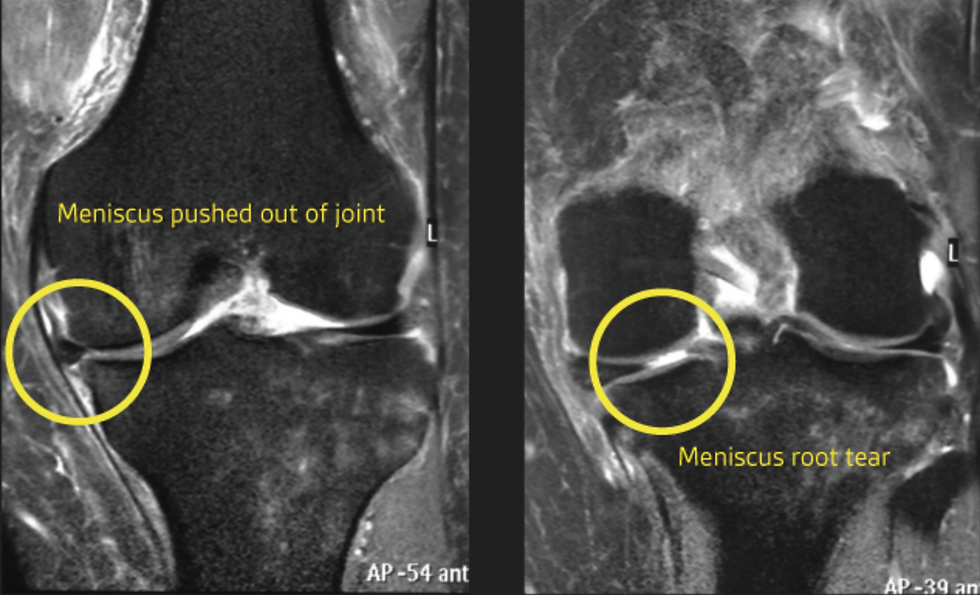
Typical MRI findings include:
Root disruption / tear
Meniscal extrusion (meniscus moving out of the joint)
Bone marrow swelling
Early cartilage damage (if patient presents late)
Associated ligament injuries (if present)
B) Scanogram
After a meniscus root tear is diagnosed on MRI, a weight-bearing standing X-ray scanogram from hip to ankle is recommended to understand the alignment of the entire leg, which is crucial in decision making.
Can a meniscus root tear heal without surgery?
Unfortunately, the blood supply around the meniscus root is limited, making spontaneous healing very rare.
Only cases in which the root is avulsed with a chip of bone attached to it (bony avulsion), may heal in early stages, provided adequate rest is taken.
What is the treatment?
A) Non-Surgical Treatment
Conservative treatment includes:
Activity modification: avoiding stair climbing, sitting on the floor, squatting
Anti-inflammatory medications: for short term relief
Physiotherapy: strengthening hip & thigh muscles
Weight reduction: reduces excessive load over the joint
Knee braces: temporary support for the joint
Injections: hyaluronic acid or platelet-rich plasma (PRP) in selected patients for early arthritis
While these treatments can improve the pain temporarily, they cannot restore the torn meniscus structurally and functionally.
B) Surgery: Arthroscopic Meniscus Root Repair
For well selected patients, arthroscopic root repair gives the best results.
This minimally invasive procedure is performed through two to three small key-hole incisions.

During the surgery, torn root is re-attached to the bone using high-strength sutures, which are passed through a bone tunnel and tied over a metal disc or an anchor.
Repairing the root helps restore normal knee mechanics and protects the cartilage from further damage.
Ideal candidates for the surgery are:
Patients seeking early treatment after an injury
Meniscus extrusion less than 4mm, with good tissue quality
Grade I-II arthritis of medial compartment of the knee
Patient ready for strict compliance to rehabilitation after the surgery
How is the recovery after a root repair surgery?
Recovery requires patience because the repaired meniscus needs time to heal.
Patient needs to walk with a walker or crutch support without putting weight on the leg for minimum 6 weeks.
A typical rehabilitation programme includes:
First 6 weeks
Long knee brace
Non weight-bearing walking with a walker or crutches
Controlled knee bending exercises
6 to 12 weeks
Gradual increase in weight bearing
Muscle strengthening
Near complete knee bending
3 to 6 months
Return to normal daily activities
Progressive strengthening
Balance and functional exercises
Sports involving running, jumping, squatting or pivoting are resumed only after 6 to 9 months, depending on the healing and rehabilitation progress.
Can a meniscus root tear be prevented?
Although not every injury can be prevented, you can reduce the risk by:
Maintaining a healthy body weight
Strengthening thigh and hip muscles
Avoiding sudden twisting movements
Using proper techniques while exercising
Seeking treatment for knee pain early
When should you see an orthopaedic surgeon?
Seek a medical advice if you have:
Persistent inner side knee pain
Swelling after a twisting injury or a pop
Difficulty in climbing stairs
Knee locking or catching
Symptoms lasting more than a week
Early diagnosis offers the best opportunity to preserve the meniscus and delay arthritis.
To summerise..
> A medial meniscus posterior root tear may be small in size, but its impact on knee health can be significant.
> Even if the pain may get better in a couple of months, it will restart once the arthritis starts to set in. So don’t ignore it.
> Ignoring the injury can lead to rapid cartilage damage and osteoarthritis in young age.
> Fortunately, advances in arthroscopic surgery now allow surgeons to repair the torn root and restore the meniscus to its natural position in carefully selected patients. Thus, it is completely curable.
If you are experiencing persistent knee pain after a twisting injury or have been diagnosed with a meniscus root tear, consult Dr.Ajinkya Achalare for expert advice, specialised care and complete recovery. Dr. Achalare is exclusive arthroscopy and joint preservation surgeon and deals with these patients on a regular basis.


Comments