


AC Joint Dislocation of Shoulder

- Acromioclavicular (AC) joint is a small accessory joint on the top of shoulder. It plays a crucial role in shoulder stability. Injury to this joint can significantly alter the movements and strength of the shoulder joint.

- Dislocation of this joint is a common shoulder injury, especially after a road traffic accident, fall from height, among individuals
involved in contact sports or high-impact activities.
- Injury can range from a mild sprain to complete disruption, depending on the severity of ligament damage.
- Management of such injuries greatly depends on the severity and time since the injury.
- Understanding some basics about this injury will help you suspect it early and seek an appropriate treatment on time.
What is an AC Joint?

The acromioclavicular (AC) joint is a small joint on the top of the shoulder where the collarbone (clavicle) meets a part of the shoulder blade (acromion). Even though it’s small, it plays an important role in keeping your shoulder stable and moving it comfortably.
What is an AC Joint Dislocation?
An AC joint dislocation, often called a 'shoulder separation’, happens when the ligaments holding this joint together are either stretched out or torn. This usually occurs after a fall directly onto the shoulder, which is common in sports, bike accidents or a simple slip & fall.
How does it happen?
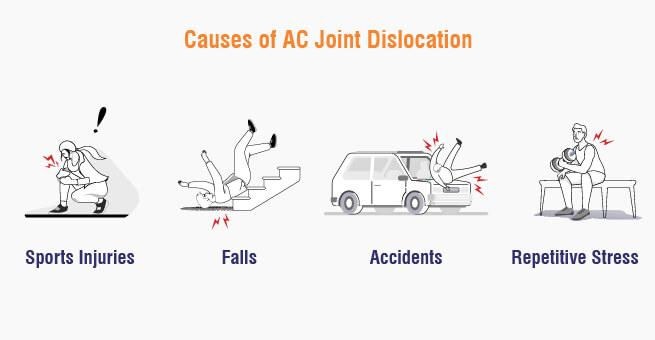
The most common reasons include:
Road traffic accidents
Falling on the shoulder during sports
Falls at home, especially on a hard surface
Repetitive stress from heavy activities
When to suspect if you have an injury to AC joint?
You will notice:
Pain on the top of the shoulder
Swelling and/or bruising
Difficulty lifting your arm
A visible bump on the shoulder (in more severe cases)
The severity of symptoms depends on how badly the ligaments are injured.
How is it diagnosed?
Radiographs (X-ray) form the mainstay diagnostic modality. When taken in proper manner, X-rays are sufficient to diagnose and classify the injury.

Following X-ray views are routinely prescribed:
AP view (both sides - for comparison & calculating CC distance)
Zanca view
Rarely performed:
Cross-arm adduction view (to differentiate between type 3A & 3B)
Weight bearing view (in case of doubtful injuries)
How is the severity of AC joint injury classified?

AC joint injuries are graded into 6 types using Rockwood classification in increasing severity.
Type 1 – Mild Injury
Ligaments are stretched but not torn
Symptom: Mild pain over shoulder
Type 2 – Moderate Injury
One ligament (AC) is torn, others (CC) are intact
Symptom: Pain with some swelling
Type 3 – Complete Tear
All main ligaments are torn
3A- stable, 3B- unstable
Symptom: Pain + visible bump on the top of shoulder
Type 4, 5, 6 – Severe Injuries
Collarbone is significantly displaced
Muscles and ligaments are badly damaged
Symptom: Severe pain + very prominent bump
How is AC joint injury treated?
Treatment of AC joint injury depends on how severe the injury is.
A) Mild to Moderate Injuries (Type 1 & 2)
No surgery is needed.
Treatment includes:
Arm sling support (1–2 weeks)
Ice packs to reduce swelling
Pain medications
Early gentle shoulder movement
Recovery time: 2–6 weeksOutcome: Excellent. Most people return to normal life quickly and can resume heavy activities within a couple of months
B) Type 3: The Grey Zone
This is where treatment depends on your lifestyle & functional needs.
Conservative treatment: preferred if
Type 3A (stable) injury
You have a sedentary lifestyle
You are not involved in high-level sports
Surgery: recommended if
Type 3B (unstable) injury
You are a professional athlete
You lift heavy weights regularly
Pain or weakness persists despite of conservative management for 2 months
Recovery: 3-6 months
Outcome: Good with or without surgery in type 3A but better results in with surgery in type 3B
C) Severe Injuries (Type 4, 5, 6)
These injuries are complex and need a surgery to restore the anatomy and function.
Why surgery?
To realign the joint
To restore shoulder strength and function
To improve cosmetic appearance
Modern surgeries are often minimally invasive (arthroscopic) and give very good results.
What are different surgical treatment options?
If surgery is needed, the goal is to bring the collarbone back to its normal position and reconstruct the torn ligaments. There are several safe and effective techniques:
Hook Plate Fixation: A metal plate and screws are used to hold the joint in place temporarily. It needs need removal after healing.
Suspensory Fixation: Strong sutures and small buttons stabilise the joint. This is performed using minimally invasive (arthroscopic) surgery.

Suspensory fixayion of acute AC joint injury Ligament Reconstruction: Damaged ligaments are rebuilt using a tendon graft (either from your body or a donor). This is preferred when the injury is severe to begin with or when the patient presents late after injury (beyond 3 weeks).
Your surgeon will choose the best method based on your injury type, activity level, and expectations.
How is the expected recovery?
Mild injuries: Full recovery is almost certain
Moderate injuries: Fairly good outcomes
Severe injuries: Good results with timely surgery and supervised rehabilitation. Delay in treatment can worsen the outcomes.
Some patients may notice a small bump on the shoulder even after the treatment, but it usually does not affect the shoulder function.
When should you see an Orthopaedic Surgeon?
Seek medical help if:
You have severe shoulder pain after an injury
You notice a deformity or a bump
You cannot lift your arm
Key Takeaways
AC joint dislocation is common but completely treatable
Most cases do NOT need surgery
Early treatment leads to faster recovery
Supervised physiotherapy is essential for complete recovery
To summarise..
AC joint injury may look alarming, especially if there is a visible bump, but the good news is that most patients recover very well and return to normal activities. The key is early diagnosis, appropriate treatment, and guided rehabilitation.
If you have suffered a shoulder injury recently, consult Dr.Ajinkya Achalare at ArthroSports Speciality Orthopedic Clinic for expert advice and treatment.


Comments